Dead eagles, p.1
Dead Eagles, page 1


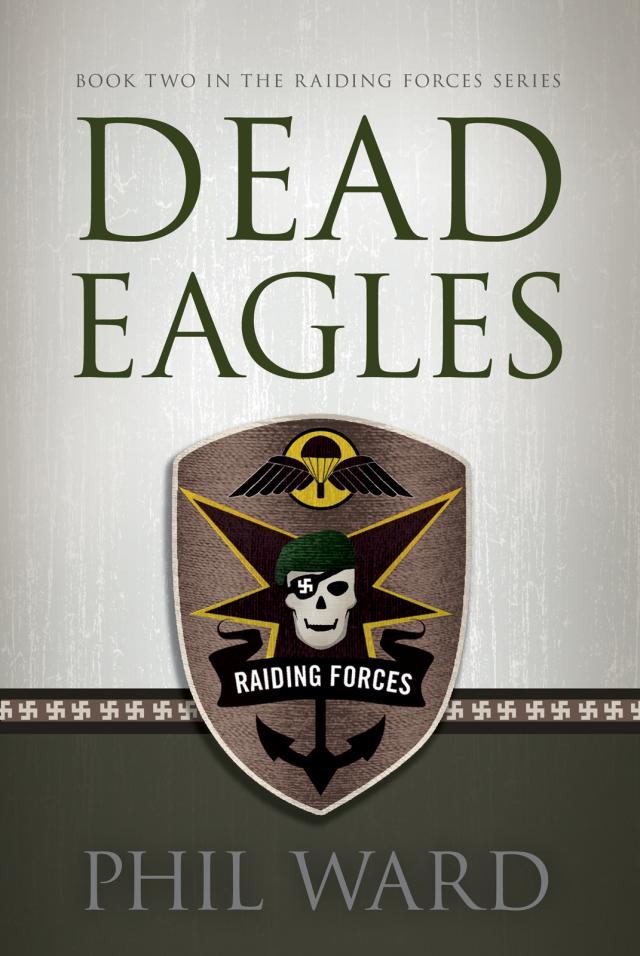
BOOK TWO IN THE RAIDING FORCES SERIES
DEAD
EAGLES
PHIL WARD
This book is a work of fiction. Names, characters, businesses, organizations, places, events, and incidents are either a product of the author’s imagination or are used fictitiously. Any resemblance to actual persons, living or dead, events, or locales is entirely coincidental.
Published by Greenleaf Book Group Press
Austin,Texas
www.gbgpress.com
Copyright ©2012 Phil Ward
All rights reserved.
No part of this book may be reproduced, stored in a retrieval system, or transmitted by any means, electronic, mechanical, photocopying, recording, or otherwise, without written permission from the copyright holder.
Distributed by Greenleaf Book Group LLC
For ordering information or special discounts for bulk purchases, please contact
Greenleaf Book Group LLC at PO Box 91869, Austin, TX 78709, 512.891.6100.
Design and composition by Greenleaf Book Group LLC and Bumpy Design
Cover design by Greenleaf Book Group LLC
Ebook ISBN: 978-1-60832-205-3
Ebook Edition
DEDICATION
DEDICATED TO DAN SAVAGE, A LONGTIME FRIEND, TWO-TIME publisher of the Waco Tribune-Herald (now retired for the second time), gentleman longhorn rancher, and daredevil motorcycle rider extraordinaire. Without Dan’s encouragement, the Raiding Forces series would never have seen the light of day.
RANDAL’S RULES FOR RAIDING
RULE 1: The first rule is there ain’t no rules.
RULE 2: Keep it short and simple.
RULE 3: It never hurts to cheat.
RULE 4: Right man, right job.
RULE 5: Plan missions backward (know how to get home).
RULE 6: It’s good to have a Plan B.
RULE 7: Expect the unexpected.
STRATEGIC RAIDING FORCES’ ONGOING OPERATIONS
OPERATION COMANCHE YELL
RAIDING FORCES’ ATTACK ON THE RAIL LINES THAT RAN ALONG the coast in enemy-occupied France came about as a direct result of failure. Lieutenant Randy Seaborn, the captain of His Majesty’s Yacht Arrow, had found it impossible to locate the tiny pinpoint targets they intended to raid with the primitive navigational equipment he had on board the yacht in time for Raiding Forces to go ashore, conduct a raid, and return home before daylight.
One night in the Blind Eye Pub, the bar Raiding Forces shared with two squadrons of hard-fighting Royal Air Force fighter pilots, after Captain Terry “Zorro” Stone ran through a litany of the problems the Commandos had encountered trying to find their targets, Major John Randal declared: “If we can’t find the pinpoints, why not quit looking for them? There are two types of targets: point and area. What’s an example of an area target we can raid instead?”
“Rail lines,” Sergeant Major Maxwell Hicks volunteered. “They run along the coast, and we can attack them at any place and get the same result.”
Raiding Forces conducted their first raid on a railroad the next night. Following that initial successful operation, small-scale demolition missions were carried out on a regular basis against the enemy rail transportation system.
OPERATION BUZZARD PLUCKER
The sniping of Luftwaffe pilots at their landing grounds in France was born out of frustration and envy. The Battle of Britain—being, it seemed, entirely fought by fighter pilots—supplied most of the frustration as well as all the envy. There was no way any of the Raiding Forces Commandos were going to get to be fighter pilots, so they sat around evenings in the Blind Eye Pub surrounded by the partying “Gallant Few” celebrating their latest air victories, drowning their frustration in alcohol and kicking around ideas on how to get into the fight.
Raiding organizations spend a lot of time dreaming up wild schemes to employ their unique skills. They have to, because no one else is going to do it for them. The regular services—army, navy, and air force—would have been perfectly happy at this stage of the war, in 1940, if the Commandos had simply faded away and never asked them to support another operation that took up their precious resources of time, men, and equipment. Raiding Forces had to find a mission and some way to carry it out on their own.
The Luftwaffe had a tactical air support problem, Raiding Forces learned from the fighter pilots in the Blind Eye, and they wanted to take advantage of it. The German dilemma was something called “air-loiter time over target.” After linking up with the bombers and escorting them across the English Channel, the Luftwaffe fighters usually only had fifteen to twenty minutes of fuel left before they had to turn around and head home. That meant the German bombers were left unprotected from the furiously attacking English fighters. It was believed that the Luftwaffe was losing more fighter aircraft from running out of fuel and crashing into the English Channel than from being shot down.
The simple solution for the Germans to reduce their time-over-target problem for their fighters was to build their landing grounds as close to the Channel as possible to reduce their flying time to Great Britain. Literally hundreds of small Luftwaffe landing grounds were scattered along the coast of France. Raiding Forces’ personnel spent many nights in the Blind Eye concocting wild schemes on how to go about taking advantage of what appeared to be a golden opportunity—handy objectives ripe to be raided that were strategic in value.
The problem was that although the German army had made a name for itself as the masters of blitzkrieg, or “lightning war,” serious students of German military tactics—meaning those who had faced them in battle and lived to tell the tale—knew that the real Nazi tactical long suit was the counterattack. The Germans were the best counterattack artists in the business and possessed of a military doctrine that demanded an immediate response to any enemy incursion.
That was very important for hard-drinking British Commandos to keep in mind. Especially while contemplating slipping over the English Channel some dark night and pouncing on one of those juicy Luftwaffe landing grounds situated so temptingly close to the coast. The Germans were going to react with the wrath of Thor, guaranteed.
“Butcher and bolt,” Prime Minister Winston Churchill beseeched Combined Operations. The problem lay in the bolting. Following any raid, the raiding party would have to reassemble, return to their boats, and re-embark to sail safely home. The talent the Germans displayed for speedy counterattacks almost guaranteed a fighting withdrawal. Attempting an amphibious re-embarkation in the dark of night, while under close ground attack, is a guaranteed recipe for disaster. Suicide missions being frowned on in Raiding Forces by those who would be expected to participate, there was no real reason to plan any. It is always wise to review stratagems concocted over drinks in a bar, pub, or club at a later date.
Still, the best place to destroy an enemy airplane is on the ground.
The breakthrough came one evening in the Blind Eye when Squadron Leader Paddy Wilcox, the Raiding Forces pilot, mentioned that the time it took to build an aircraft could be measured in hours, but it took years to develop a skilled combat aviator. “Battle experienced airplane drivers are worth their weight in diamonds.”
“Bingo,” Major John Randal announced from the big easy chair where he had been semi-dozing by the fireplace. “We’ve been looking at this all wrong, boys. What we need to do is quit trying to figure out how to attack the German airfields and go kill pilots.”
Once you break a logjam in thinking, thoughts and ideas often come fast and furious.
“We can find a location where pilots congregate and raid it, or we can land sniper teams from the Arrow and they can snipe pilots at their landing grounds,” the Raiding Forces’ commander added.
“Or,” Squadron Leader Wilcox suggested, “I can insert and extract the snipers from a nearby lake by light amphibious airplane, exactly the way I used to fly in trout fishermen.”
“Where do we obtain snipers, old stick?” Captain Terry “Zorro” Stone inquired. “One would imagine sniping would require a great deal of skill.”
“Lovat Scouts,” Sergeant Major Maxwell Hicks said. “The most peerless stalkers and snipers in any army anywhere. Lovat Scouts can turn themselves invisible, and if they can see it they can hit it.”
Raiding Forces’ mission to kill German fighter pilots was born on the spot.
Captain the Lady Jane Seaborn, Raiding Forces’ liaison to the hush-hush Political Warfare Executive, briefed them on Operation Buzzard Plucker. PWE immediately saw possibilities. They suggested that the Lovat Scout sniper teams be outfitted with standard issue German army boots. This idea had two benefits. It made it impossible for the Germans to track the scouts because of the millions of Nazi boot prints. And since standard issue German army boot prints would be found in the snipers’ hide positions outside the landing grounds after the attacks, the conclusion would be inescapable that people within the German military, members of a phantom anti-Nazi resistance movement, were responsible for shooting the Luftwaffe pilots.
PWE implemented two additional operations of their own—in effect, missions within the mission—in conjunction with Buzzard Plucker.
Operation Limelight
The first PWE extra mission involved Squadron Leader Paddy Wilcox dropping parachutes weighted down by blocks of ice when he flew over enemy-occupied France to either insert or extract the Buzzard Plucker sniper teams. PWE’s idea was for the empty parachutes lying on the ground after the ice melted to cause the German security forces to believe that British agents had parachuted into a cer tain area. The Nazis would have no choice but to conduct manhunts for nonexistent infiltrators, and since they would never find any, live with the fear that British secret agents were running around the country up to mischief.
Operation Whistle
Once again, the PWE envisioned Squadron Leader Paddy Wilcox dropping something from the Walrus amphibian he flew during Operation Buzzard Plucker. This time it involved scattering dead carrier pigeons over enemy-occupied France. PWE placed fake messages inside capsules attached to the dead pigeons’ legs in hope that the Germans would find the fallen birds and read the messages. The fake messages were designed to encourage the Nazi security apparatus to believe that an active anti-Nazi resistance movement existed within the German army. It would appear that the resisters were assassinating the Luftwaffe pilots and attempting to report their success to the British Secret Intelligence Service by carrier pigeon.
Currently, all operations had been placed on temporary stand-down. Strategic Raiding Forces had been alerted for a “Most Secret” mission in another part of the Empire. That it was deemed more important was an indication of just how vital the operation was.
STAGING FOR DEPLOYMENT
1
STANDING DOWN BUZZARD PLUCKER
Somewhere in France
OPERATION BUZZARD PLUCKER, THE SNIPING OF GERMAN FIGHTER pilots at their landing grounds in enemy-occupied France, had been ordered to stand down. Strategic Raiding Forces, the small Commando unit conducting the mission, had been alerted for another operation with a higher priority. The two Lovat Scouts—wearing gillie suits in the hide position from which they now observed Luftwaffe Landing Ground 279—had no way of knowing their mission had been called off. Their only means of communication was a pair of carrier pigeons carried in little cardboard containers, each about the size of a softball. The snipers, Scout Jock MacDougal and Scout Bill Frazier, could send a message back to Seaborn House, Raiding Forces’ headquarters located in the south of England, but they were unable to receive one.
The team had been inserted by HMY Arrow. They had encountered no problems making their way ashore, both going barefoot, Scout MacDougal walking backward carrying Scout Frazier piggyback. Any German beach patrol happening along the following morning would see only the innocent-looking footprints of a lone swimmer and have no cause for alarm.
The team laid up for a half hour to see if the landing had been detected or if the beach was under observation.
After determining that everything was clear, the Lovat Scouts found a good hide position and put on German army boots so their prints would blend in with the million or so other pairs of Wehrmacht boots tramping around Normandy. Britain’s Political Warfare Executive had wanted to create the impression the Lovat snipers attacking Luftwaffe landing grounds were anti-Nazi dissident members of a resistance movement within the German Armed Forces, not British Commandos. No such anti-Nazi resistance movement existed, but British intelligence hoped to strike at the psyche of the German High Command.
The Lovat Scouts had no knowledge of that. They did not have a need to know. What they were perfectly clear on was that the purpose of the exercise was for them to shoot as many Luftwaffe fighter pilots on Landing Ground 279 as possible when the opportunity presented itself as the squadron scrambled for takeoff.
The pair of snipers moved out toward their objective, taking the normal precautions not to be tracked—walking backward at times, circling, stepping on rocks and wading in streams, carrying each other piggyback for short stretches. They moved inland for a mile.
At approximately 0400 hours they reached the vicinity of their objective. The men moved into an area of thick forest where they waited in deep concealment until daylight gave them an opportunity to glass the German airfield and select the most suitable position from which to take their shot.
The Scouts would take the better part of the day to move into their final position. The Lovat Scouts were peerless stalkers. Raiding Forces, being shot through with men from the King’s Royal Rifle Corps and the Rifle Brigade, had a number of men who were as capable marksmen, but no one was in the same league as the Scouts when it came to sneaking and peeking.
The shooter, Scout MacDougal, was armed with a scoped Wesley-Richards 7x57 rifle that his father before him had carried in the Great War as a Lovat Scout Sharpshooter and had presented to his son on his twelfth birthday. The commonplace 7x57 caliber was in fact a German military round ideal for the mission because a spent cartridge case was not a giveaway as to who had fired it. It could be anyone. With a little luck Nazi intelligence would find the brass and believe the sniper was a German soldier.
The glassman, Scout Frazier, the team leader, was carrying the 20X Ross telescope he used in happier days to spy out the wily red stags that inhabited the remote Scottish highlands. He was armed with a captured German MP-38 submachine gun.
Both men were highly trained reconnaissance experts skilled at what the Lovat Scout Regiment called SOS—Scouting, Observation, and Sniping. The glassman carried a Scouting, Observation and Sniping logbook. On each page of the book was a grid for Time, Map Reference, Event, and Remarks. They carefully recorded what they observed, being scrupulously careful not to give their opinions or interpretations of events.
The landing ground before them was laid out exactly as they had been shown in the aerial photos they studied prior to the mission. It was a military airstrip designed for function, not beauty: A single grass strip was surrounded by concertina and razor wire. Twenty-foot-tall guard towers built on telephone-pole stilts were spaced every two hundred yards around the airfield. Several small buildings sat at the far end of the landing ground. The open-topped control tower was mounted on the roof of what they had been briefed to believe was the field operations building. It was sandbagged waist high at the top.
A squadron of Messerschmitt Bf 109s was operating off the field. The snipers could see a total of thirteen high-performance, single-seat fighter aircraft. Each plane had a large red heart painted on the side of the nose just behind the propeller. Each heart had an arrow piercing all the way through it, slanted down from left to right. A sketch of the insignia went in the SOS log that Scout Frazier carried in the billows pocket of his sand green Denison smock.
The two Scouts observed enemy pilots, ground crew, operations staff, and maintenance and security personnel. Guards were manning the front gate and the towers and were roving the perimeter. No sizable number of ground troops to mount a quick reaction force appeared to be stationed at the landing ground. The Scouts thought that was good.
None of the aircraft had an individual guard posted to it, and the perimeter guard towers were manned by only one sentry at all times. An occasional two-man foot patrol strolled around the perimeter road running inside the strands of barbed wire. Nevertheless, the German soldiers appeared to be thorough and professional, taking their time to check for any visible signs of an intruder crossing the fence.
The pilots, the Eagles, spent their time playing with a soccer ball, lounging in overstuffed chairs their batmen had moved outside on the lawn for them, or sleeping on cots beside their airplanes.
The Raiding Forces sniper team expected the German pilots to launch a dawn patrol, and they were not disappointed. Beginning Nautical Twilight, however, was still too dark to allow the snipers to take their shot as the Me-109s took off.
Eventually the squadron returned, landed, rearmed, and refueled. The pilots went back to their soccer, lounging, and napping as per the day before. Ground crews worked on individual aircraft.
“AH-OO-GHA, AH-OO-GHA, AH-OO-GHA,” the klaxon sounded at 1023, and the pilots scrambled. The instant the signal went off, one of the ground crew jumped into the cockpit of each fighter and fired up the engine while the thirteen pilots raced to man their machines. Some pilots ran on foot, some rode bicycles, and others hopped on the back of a flatbed truck that drove around the perimeter dropping off the Eagles at their assigned aircraft.