Wired for madness, p.1
Wired for Madness, page 1


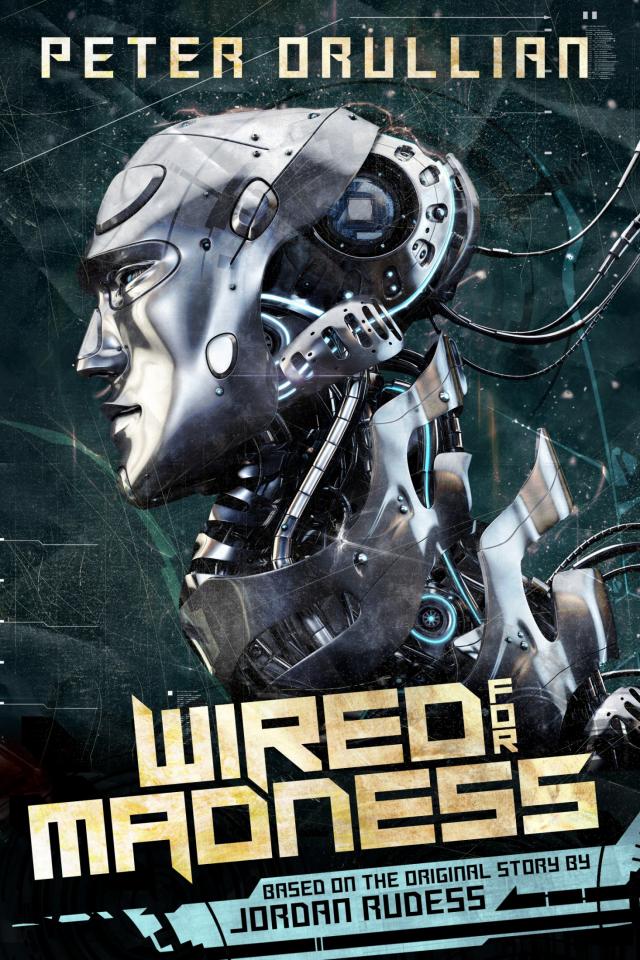
Wired for Madness
Peter Orullian
Based on the original concept by Jordan Rudess
Praise for
THE SOUND OF
BROKEN ABSOLUTES
from the epic fantasy series
THE VAULT OF HEAVEN
“The Sound of Broken Absolutes is one of the most beautiful stories I’ve ever read . . . stunningly gorgeous, painfully intimate, and magnificently epic. This is a story of war, music, loss, and restoration, and it will touch the hearts of its readers.”
~ The Ranting Dragon
“The Sound of Broken Absolutes offers a theme of rebuilding our broken selves. It resonates perfectly. Orullian pours love and dread into his rich novella about art, loss and reconstruction. His tale disturbs and ultimately uplifts with the authenticity only possible from a writer who looked life’s hardship in the eye and shook its bony hand.”
~ PasteMagazine.com
Praise for
THE UNREMEMBERED
and
TRIAL OF INTENTIONS
BOOKS ONE & TWO
of
THE VAULT OF HEAVEN
“Engaging characters and powerful storytelling in the tradition of Robert Jordan, Terry Goodkind, and Dennis L. McKiernan make this a top-notch fantasy by a new author to watch.”
~ Library Journal (Starred review)
“A sprawling, complex tale of magic and destiny that won’t disappoint its readers. This auspicious beginning for author Peter Orullian will have you looking forward to more.”
~ Terry Brooks
“The Vault of Heaven is an ambitious story in the mold of Robert Jordan and Terry Goodkind. Peter Orullian is a name to watch in the field of epic fantasy.”
~ Kevin J. Anderson
“This is one huge, powerful, compelling, hard-hitting story . . . The Vault of Heaven is a major fantasy adventure.”
~ Piers Anthony
“A fine debut!”
~ Brandon Sanderson
“Great fantasy tales plunge us into vivid new worlds, in the company of fascinating characters. The Vault of Heaven is great fantasy. It grips you and shows you true friendship, strange places, and heroes growing to confront world-shaking evil. Magnificent! I want more!”
~ Ed Greenwood
“The Vault of Heaven by Peter Orullian is a vast canvas filled with thought-provoking ideas on the questions of good and evil that engage us all.”
~ Anne Perry
“Intricately crafted with its own distinct melody, The Unremembered is a groundbreaking work of epic fantasy.”
~ Bookwormblues.net
“Sometimes you just need a big, fat fantasy, and Peter Orullian’s remastered edition of The Unremembered delivers everything you’re looking for: a fascinating world, tense action, charismatic characters, and a magic system the like of which you’ve never imagined.”
~ Aidan Moher
A Dribble of Ink
Hugo Award Winner
“The Unremembered captures the unique essence and mystery of music, and weaves it into every line of a compelling and exciting world, while telling a character-driven story that resonates through the ages . . . a work of art on par with the masters of the genre, Jordan, Rothfuss, Tolkien, and more.”
~ Elitistbookreviews.com
2013 & 2014 Hugo-nominated
for best review site
“Engaging characters, complex magic, and expertly written—a whole new kind of epic fantasy!”
~ Suvudu.com
“Trial of Intentions is a story of music and magic, of daring and sacrifice, in an intricate and believable world, where characters face difficult and heartbreaking choices. Orullian is doing things I haven’t seen in other books, including an original system of magic. This tale will resonate with readers long after the cover is closed.”
~ Robin Hobb
“Peter Orullian’s Trial of Intentions is a book enormous in scope and in intricacy, with a welter of political, cultural, and magical intrigues, behind which lies the role of song in preserving a myriad of cultures, all of which disagree with each other to some extent, even as it becomes apparent to the reader that, without some degree of cooperation, all will suffer, if not perish. A challenging story about challenged cultures, and one well-told.”
~ L. E. Modesitt, Jr.
“Peter Orullian is a master of dark chocolate fantasy; bitter, harsh and sweet at once. Trial of Intentions grabs us firmly by the breastplate and challenges us to face a world of moral contradictions, stunning characters and harsh choices. An unflinching fantasy.”
~ Tracy Hickman
“Trial of Intentions is a grand novel, with strong worldbuilding and a sweeping cast of distinctive characters. Orullian is a promising writer, and I look forward to seeing where he takes us in the future.”
~ Brandon Sanderson
Also by Peter Orullian
The Astonishing
The Unremembered
Trial of Intentions
The Sound of Broken Absolutes
The Vault of Heaven – Story Volume One
Beats of Seven
At the Manger
(Forthcoming collaboration with Brandon Sanderson)
Contents
Start Reading
About the Author
Table of Contents
Wired for Madness
Copyright © 2019 by Peter Orullian
Cover Design by Shawn King
All rights reserved
Wired for Madness is a work of fiction. All of the characters, organizations, and events portrayed are either products of the author’s imagination or are used fictitiously.
Published by
Descant Publishing
10 9 8 7 6 5 4 3 2 1
To my son, Alex Orullian
Because he makes me laugh
ACKNOWLEDGMENTS
There are always so many people to thank when it gets right down to it. And that list can stretch all the way back into childhood. But I’d like to go a simpler route this time around. I’d like to thank just one person: Jordan Rudess.
It may be a surprise to anyone reading this novella that I’d thank the man who made it possible. But my thanks isn’t about the opportunity to write a story to his amazing new album, Wired for Madness. Instead, my thanks is to a guy who has always been accepting and encouraging. He listens when you talk; he responds thoughtfully. He’s calm when so much seems frenzied.
I want to acknowledge Jordan because he’s always been a good friend—supportive, willing, and happy for others’ success. Taken together, this is rare, at least in my experience. And I wanted him to know that he’s influenced my life for the better. All of which made it an honor to write a story first begun in his creative mind.
So, thank you, Jordan. You’re top drawer.
A NOTE FROM JORDAN
The concept for "Wired for Madness" came to me pretty organically. It's a description I've often attributed to myself and the way my brain processes and creates on a sonic level. My initial idea was to write an epic musical composition around the concept. I had a seed of the story in my mind. It was to be a futuristic vision of someone who, in the throes of mental and physical decline, decides to undergo a new medical procedure that would computerize a large fraction of his being, therefore effectively relinquishing some of the tasks he was no longer humanly capable of managing to the powers of the "machine."
For the past several decades, my dear friend Shem Cohen has been an incredible source of inspiration, creativity, and support for me both personally and professionally. His artistic insight was critical to the realization of "Wired for Madness."
I'm both thrilled and extremely impressed that Peter was able to transform this musical pandemonium into a book. It’s a wild ride and you are in for an awesome adventure!
Thank you to my beautiful family, my wife Danielle and daughters Ariana and Kayla, for ceaselessly supporting me on my creative journey, and thank you to Shem Cohen, who has been a pillar of inspiration and support for the past 40 years.
Wired For Madness,
Jordan
CHAPTER ONE
PERFECT MOMENTS COME at the strangest times. You don’t expect them. You don’t even know they’re perfect without the benefit of hindsight. But then, like a cactus flower on the desert plain, they unfold with a touch of light, their memory gently fixing hope inside an otherwise barren heart. For me, such a moment came as Michelle and I pushed through a nasty thundershower as we rushed to make a friend’s wedding reception.
The wind drove the rain into the windshield so hard that it sounded like the glass might crack. Even with the wipers turned all the way up, visibility only reached ten feet down the expressway. Taillights winked ahead of us as drivers pumped their brakes.
“We’ll be fine,” Michelle said, glancing at me from the driver’s seat. “I grew up in Oklahoma. These nor’easter storms are weak by comparison.”
I smiled and nodded. “Marc and Heather would have understood if we’d decided not to drive in. Manhattan’s going to be a nightmare.”
“You’re right on both counts.” Michelle put a hand over mine. “But they came to our reception. So, you can be damn sure we’re going to theirs.”
“Both hands on the wheel, dear one,” I replied.
The rain was hammering the car worse now, giving our little VW bug the feeling of a protective cocoon. The heater blasted stale hot air over my feet. Michelle had the radio tuned to a big band station currently playing Tony Bennett singing “A Stranger i n Paradise.” The car’s instrument panel lit her face in a subtle glow that marked the smile she gave me, a smile of both reassurance and gentle reproof—neither helped me much.
She pulled her hand back and made a show of firmly gripping the wheel with both hands. She laughed softly. “Trust me,” she said.
The whole reason I’d asked her to drive is because I didn’t do well when I couldn’t see. Brought up an old, irrational fear I hadn’t been able beat, even after earning an advanced degree in Psychology from Brown and treating others with the same damned phobia. Michelle was a better therapist than I was, and even she hadn’t been able to help me past it.
I stared at her a long moment. In our cocoon, with warm air and Tony Bennett, I stared at her. And slowly my tension began to ease, because I did trust her. I absolutely did. That was my perfect moment. In the eye of the storm with the woman I loved, reassured and content.
Then her smiling lips parted, pulling back over her teeth. Her mouth gaped open, her eyes flashing wide. She slammed on the brakes, but the car didn’t slow and began to drift to the right. We were hydroplaning down the freeway.
Michelle screamed. Reflexively I jammed my foot against the floor—as if I had a brake on my side—and grabbed the dashboard, bracing.
“Robert!”
“Steer into it!” I shouted. “Steer into it!”
Taillights flared through the rain. The heavy sound of crashing metal shot through the night, overpowering Tony Bennet. It all happened so smooth and graceful, the VW coming around until I was staring out my window into the rain and flashing lights.
A second later we slammed into the rear end of a small car—a Fiat, maybe—the force whipping us against our seatbelts. My door buckled, driving a wedge of metal into my arm and leg. I felt bones break, pain radiating up and down my body.
Then great bright lights filled the VW. I turned as a horn blasted into the storm. A semi.
It piled into the driver’s side, its huge bumper and radiator folding our little car like a matchbox. Glass shattered and sparkled like fireflies in the rig’s high-beams. The rain poured through the broken windows as though triumphant to finally have at us. Smoke and flames and the stench of hot rubber filled the air. Passing cars honked. The wind tore at voices shouting for help.
My vision came in-and-out, my head splitting like a migraine had gotten righteous hold of me. And before the thought to look for Michelle could fully form, everything went black . . .
~ * ~
I HOBBLED DOWN the hospital corridor. They’d set my arm and put me in a sling—a wrist fracture that would need attention later—but my leg was just deeply bruised apparently. I’d been lucky. Michelle, though . . . she’d just come out of surgery.
I found her room and pushed in, grateful I didn’t have to have a tired argument with hospital staff about not seeing her. When the door shut, the silence came broken only by the low hum of medical machines. I crossed to her bed. Dear God . . .
They had her on a respirator, IV, a couple of sensors connected to her chest and the side of her head. Data streamed across monitors to one side. The slow percussive push of air from her ventilator sounded like mechanical breathing, which, I guess, is what it was. Awful sound.
They’d cleaned her up, but her face was still a patchwork of cuts and bandages. She wore a hospital cap over her honey-blond hair, a few tufts poking out behind her ears. Her lips had swollen to twice their size. I couldn’t see her hands, since her arms were tucked beneath the sheets.
“Oh, Michelle . . .”
I’d gotten out of the habit of prayer a long while back. Part of me figured if God was there, he knew my heart without me needing to say anything, and it wasn’t likely I was going to change his mind anyway. But that didn’t slow me a single damned second in putting a prayer together for Michelle.
“Look . . . God.” I paused, letting go of some anger. “I haven’t done anything to earn your respect. What I mean is, I don’t deserve any special favors. But I’m not asking for me. I’m asking for a woman who does deserve it. And not because it would spare me some grief, but because this world would be worse off without her. You know that as well as I do. So, if there’s anything I can say or do to get your attention on her health, just let me know . . . Amen.”
It came out in a rush, sort of desperate sounding, I think. I wasn’t even sure what I was trying to say. Mostly, I guess, I was sharing up some of my grief, and asking for some mercy.
I sat there a long time, hours. Nurses came and went. The doctor came and went. They let me sit by, offering little information and small looks of consolation as the night dragged on.
“Dear one,” I muttered sometime later, as though she could hear me. “You’ve got to stick around. Because there’s no way I’m putting in the garden alone. I’m not even sure where you keep the seeds. Not to mention the Cognition Conference we’re supposed to speak at next month. I hate those things. And you were supposed to submit the abstract—”
A light came on, emitting a high, droning note. A few short seconds later, hospital personnel crashed into Michelle’s room, forcing me out of the way.
“What’s going on?” I said. “What’s going on! Talk to me!”
So many tubes and hoses feeding into my dear one. So many lights and charts and people all around her. One of the men ripped her hospital gown open and called out, “Clear!” He put two paddles on her chest. A jolt, and her body jumped.
Again.
How long did it all go on? I don’t know. But silence had come again when the medical team stopped trying. And Michelle was gone. In that moment I felt so very far from heaven.
CHAPTER TWO
Three Years Later
MID-MORNING SUN brightened a cloudless blue sky, against which I flipped down my sun-visor. I rolled along without the companionship of the radio, and took the Lincoln Tunnel Exit, the same as I did every day. Warm sun on cloth seats raised a bland dusty scent—a familiar smell. Best part of my commute was the sparse traffic. Worked well for me to go in late and work late. The sleep-aid drugs made getting up a chore, anyway, and I was never in a rush to get home.
Our home. The one Michelle had decorated. A place to live our lives.
I couldn’t bring myself to sell it, despite friends recommending as much. The truth, though, wasn’t that memories came back to bite me when I returned home from the office. It was more that there just wasn’t anything to come home to. All that had been before . . . was a life left behind. So, instead, I kept the routine. Just tried to live another day. It’s all I really knew anymore. The routine. It took everything I had to maintain it.
As I drove into the office, I catalogued and reviewed the daily list: late morning patients, lunch at my desk, afternoon patients, correspondence, dinner at one of three near-by diners—house specials only—back to the office to writeup the daily notes, NPR for an hour if they weren’t going off on one of their political screeds, and office tea for the drive home—one of four flavors bought in bulk at Costco.
Weekends were different only in that one of the diners was closed on Sundays.
There was another benefit of the routine not to be under-appreciated: lack of deadlines. I’d withdrawn my name for conference consideration, which meant no more abstracts or speeches or travel. I gradually stopped caring about the latest breakthroughs and treatments in the cognitive sciences, which relieved the pressure of trying to “out-therapy” other therapists. I just didn’t have the headspace.
Michelle would hate to hear that, I thought.
I parked, took the steps up to my third-story office, and got the day underway. It wasn’t until Correspondence hour that the routine took a hit.