

Sinful folk, p.1
Sinful Folk, page 1
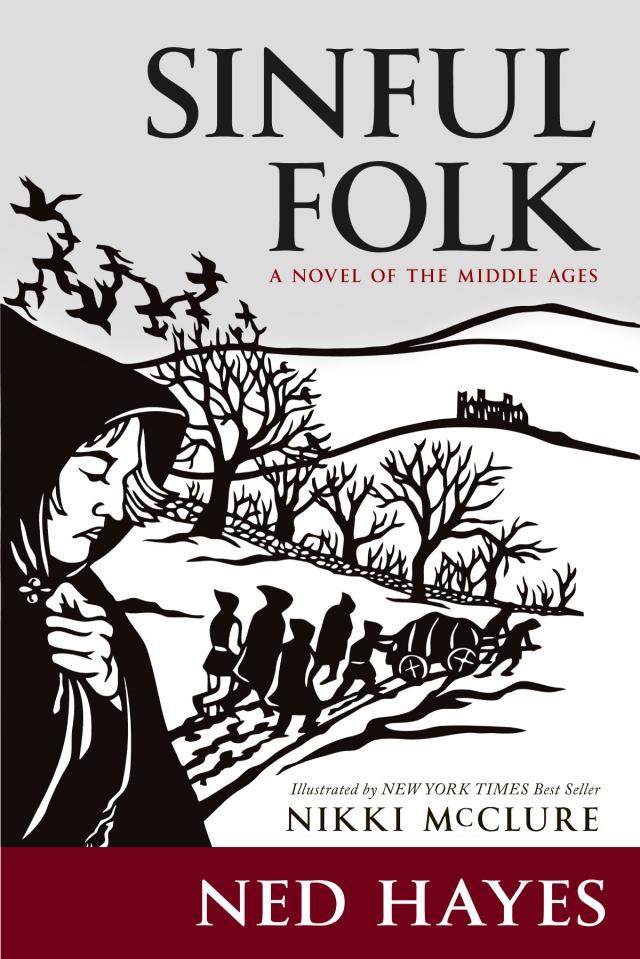


SINFUL FOLK
NED HAYES
Campanile Books
All rights reserved. Copyright infringement is against the law. To use material from this work, contact the publisher at permissions@CampanileBooks.com
Campanile Books | New York | Chicago
Copyright © 2014 by Ned Hayes
Copyright, usage, and publisher information
All Books by Ned Hayes
All books by Nikki McClure, Illustrator
Coeur d’Alene Waters (by Ned Hayes)
Campanile Books - Publisher
Pray for us, we sinful folk unstable....
My child is dead within these two weeks,
Soon after that, we went out of this town...
Up I rose, with many a tear trickling on my cheeks
—Geoffrey Chaucer,
The Canterbury Tales
A curious incident is brought to our attention from the year 1377. In December of that coldest year in the medieval records, the village of Duns in the northeast of England suffered a great tragedy. Five of its young boys were burned to death in a house fire near the center of the village.
As was common with many tragic events in that century, it was supposed the Jews were to blame. Yet all Jews were destroyed, forcibly converted, or expelled from England by order of the Crown, some fifty years earlier, in 1325.
Although most English peasants at that time had never traveled during the course of their lives more than twenty miles from the place of their birth, five men from the village of Duns loaded the charred bodies of their children on a farm cart and journeyed over two hundred miles to London. The Court record states that the villagers went to present the bodies to the King, and to demand justice against the Jews.
The historical record is clear on these few facts. History does not record any further details about the incident—neither the motivations, intentions, nor experiences of those who undertook this arduous journey are noted. Not a single person from the village is identified, not even the guilty party.
—Miria Hallum,
The Hollow Womb: Child Loss in the Middle Ages
liturgy of the hours
Lauds Aurora, the dawn prayer, to greet the day
Prime Early morning prayer, first hour, about 6 a.m.
Terce Midmorning prayer, third hour, about 9 a.m.
Sext Midday prayer, sixth hour, about noon
None Midafternoon prayer, ninth hour, about 3 p.m.
Vespers Evening prayer, at the lighting of lamps, 6 p.m.
Compline Night prayer, before retiring for sleep
Matins Vigils or Nocturns, during the hours of night
chapter i
N THE END, I listen to my fear. It keeps me awake, resounding through the frantic beating in my breast. It is there in the dry terror in my throat, in the pricking of the rats’ nervous feet in the darkness.
Christian has not come home all the night long.
I know, for I have lain in this darkness for hours now with my eyes stretched wide, yearning for my son’s return.
Each night that he works late, I cannot sleep. I am tormented when he is not here—I fear that he will never return. I lie awake, plagued by my own fears of loss and loneliness.
But my fears have never come to pass.
So on this night, I tell myself that the sound I hear is frost cracking, river ice breaking. I lie to my own heart, as one lies to a frightened child, one who cannot be saved.
All the while, I know it is a fire. And I know how near it is.
First, I could hear shouts and cries. Then there was the sound of rapid running, of men hauling buckets of water and ordering children to help.
A house burns.
Yet always I fear to venture forth, for my fright has grown into a panic that gibbers in the dark. What if someone started this fire to burn me out?
What sport would they have, watching a mute moan as she turns on the spit?
A crackle and hiss in the distance. A heavy thud, and then the roar of an inferno. Where is Christian? I must go, I—
Scrambling out of the straw, I rush to the door in my nightclothes. Then I remember poor Nell, who died last spring.
I do not forget her agony.
I blunder in the darkness, fumbling for the fireplace soot. I smear the smooth edge of my jaw, marking with trembling fingers a hint of beard on my soft upper lip and my chin.
Always, I must hide my true face.
As my fingers work, I grip hope to me, a small bird quaking in the nest of my heart. Desperately, I mumble the words of a prayer from my past.
O Alma Redemptoris . . .
My sooty ritual is perhaps my own strange paean to womanhood. Like Theresa of Avignon, that spoiled heiress of the French throne, who shared my vows at Canterbury, the world will see me only as I intend. It is a type of vanity: if I cannot be a woman, I will be as ugly a man as I can muster.
And in this ceremony, my dread subsides. My fingers stop trembling. I think clearly for a moment. Even now, perhaps Christian is one of those who carry buckets of water to fight the flames. Christian will be fine. He is strong, vital, alive. He is mine, and I am his.
All will be well. I repeat it in my head like a rosary. All will be well.
Then there are harsh shouting voices outside, men rushing toward the burning building. “Trapped!” they shout.
Now I quake with dread, for I am not finished. I should wrap my bosom tightly, bind the feminine shape of my body into that of a eunuch. But I lunge for the door, my bosom unbound, my heart full of fear for my son, and fear for my own flesh.
Even as my heart belies me, I pray that this fire is nothing. Nothing to do with my life, my secrets.
Across the village square, the largest house—the home of Benedict, the weaver—is consumed by flame. Every piece of wood smokes and bends in the fire. The roof seems supported not by heavy timbers, but by ropy masses of blazing smoke.
It is the home where my son is an apprentice.
The smoke chokes and claws at my nostrils and my throat. The roof catches in a roar of flaming darkness. The crowd churns in turmoil, seeking to save their village, their children.
Not one of the villagers pays the slightest heed to me.
I am an old man to them, and a broken, mute one at that—wiry as a starved mule, leathery with long labor. It is rare that any in this village look beyond the wrinkles and the rat’s nest of chestnut-colored hair to see my face.
Tonight, I force them to see me. I seize each of their faces with my gaunt hands, turning them, staring quickly into each pair of wild, frightened eyes. Here is that layabout Liam’s frightened pale face and red beard. He looks for his son too. Across the way is a boy wrapped in a cloak and hood. My heart lifts—is it Christian?
But when I meet that boy’s eyes, they are black as night. It is only Cole, the orphan. I see my friend Salvius, the blacksmith. He runs past, throwing water on the flames.
Then I see Tom, who hangs back in the crowd. I clutch at him, wanting answers, but Tom pushes me away, his wide-set, cowish face full of fear.
I turn. I pull down another man’s hood, and it is bald Benedict, the weaver who owns this house. He gives me a dark glance and pulls away, to lift a bucket of water.
I grasp a short man next, small Geoff, the carpenter, with the squint. “Where’s my boy?” he shouts in my face. “Where is he?”
I turn about again, I seize on every person, look into every face. I hope for only one boy, I search for his blue eyes. My son.
Christian.
Is this really all the living folk we have? Frantically, I count on my fingers. All the women accounted for and most of the men.
Only a few are not here: Jack, whose foot was trampled by a cow, and Phoebe, who is about to give birth. Benedict’s wife will be with her this night—Sophia is the closest we have to a midwife now, now that Nell is gone.
That accounts for three. But where are the older boys?
Desperately, I search each of these villager’s faces again and again—going over old ground—until they push me away.
Men and women shout their children’s names. “Breton! Matthew! Stephen! Jonathon!” The large boy who belongs to Tom. The son of the carpenter. Then the second son of the weaver. And the eldest son of Liam, the woodsman. But there is only one name that echoes in my mind, and no one shouts it aloud. My son, my only.
Christian— Christian— Christian—
The house falls half apart, split wide, a timbered carcass steaming and cracking in the winter frost. Salvius is always brave: he leaps up onto the smoldering threshold and uses a beam to batter in the smoking door. Then Liam steps into the smoke, wrapping his arms in a wet cloak.
I push my way through the milling villagers to see Liam and Salvius emerge, dragging out a charred body. Then another, and another. Five, in the end—all the missing accounted for.
My tongue forms his name, but I cannot speak a word. Instead, I give a cry—that meaningless animal groan that is my only language now.
The flames rise again, the west wind gusts strong across the heath, a demon roaring as it takes the building apart. The crackle is that of hell itself. The men run frantically with buckets of water to save the neighboring crofts.
The five bodies lie on the ground, black as broken shadows. They stink now of death. Burned flesh, scorched wool. It is a nauseating stench, yet despite myself, my mouth waters at the smell of flame-roasted meat. I am always so hungry.
A bit of metal glimmers faintly below one charred head. It is a thin silver chain. Is t hat my chain? My boy’s neck?
I am pierced to the root then, all of my veins bathed in a liquor of terror.
chapter 2
HE DAY IS almost upon us, the houses and trees silhouetted by a faint blue light in the east. The burned croft is a smoking wreck, embers steaming in the dawn.
The wind dies now. In this winter, we have had several unfortunate fires, but this is the worst yet. The crowd slows its frantic work, as the danger fades.
Now I can hear them: the cries of children, the sobs of babes in arms. No doubt those cries were all around me for hours in the crowd. Yet I had ears only for one cry, and that cry never came.
The bodies are surrounded by their families. These youth were our bleak earth’s brightest, our highest roll on Fortune’s wheel.
I go to the dead. They are blackened and unrecognizable, each boy stretched out like a penitent against the raw earth. These are other children, not mine, not mine.
But I reach out my hand, I cross them with the holy sign. My mouth moves silently in the rhythm of that last rite, although I have not a whit of faith left in me.
If I still believed in such fictions, the souls of these innocents would be trapped in limbo for eternity. A cold God to condemn children to such punishment. And my blessing means nothing: we have no priest in this village, no sacrament of burial, no sacraments at all.
The world blurs as my eyes go wet.
A voice calls my name loud. “Mear!” I turn, blind and terrified, covering my tear-streaked face. Liam’s voice is strained and hoarse. “Mear. Ah, Mear, there is no shame in tears. All of us have lost.”
Liam is the poorest man in the village, and we have lived side by side so long that I have wondered if he and his wife Kate see through my soot-stained skin to the woman underneath. I stay apart from him as much as I can, but always he talks to me, despite my silence.
Most of the villagers act as if I am of no more importance than a beast. No one here ever pays me mind. There are few who know I am alive. I prefer it that way, for I want to be invisible.
Yet I would have taken my child and left long ago except for this man, Liam, and my friends Salvius and Nell. Salvius needs me at his bellows and his smithy—he values my labor and my friendship. And Liam at least helps me laugh.
But Nell—poor Nell—she is gone.
Now Liam puts an arm around my slight shoulders, holding me as I sob. There is no laughter in him after last night. His green eyes are full of water, and his red beard trembles.
“Oh, Mear, thank you for blessin’ their souls.”
Who else has seen me bless and cross the dead?
But Liam does not care that I make the sign reserved for priests and nuns. He mourns over his son, and then he turns to look at another body, close at hand.
“I think here’s your lad. Seems to me it has to be him. He was the last one I brought out—the tallest and the furthest from the door.”
And when he says this, I cannot pretend any longer, I cannot wish away this hard truth. The silver chain glimmers faintly in the dawn light—it does not lie. I fall to my knees. Here is my beloved, my son.
Liam bends down to his own firstborn son, burned and blackened on the ground. A groan comes out of the stricken father, an anguished sound to shake the earth.
Now the crowd swells and crests under the whip of a mad grief.
Tom is slavering out some half-remembered tale, a demonic vision. “This is the work of those who killed the Christ. They are cursed—infested with the devil’s seed! They drink children’s blood in the night!”
Everyone knows this is the third terrible fire we have had this winter. This time, it was Benedict’s weaving house that burned, and some in the crowd move toward his family.
“Why were the lads here?” cries Geoff, the carpenter. “Why were they burned?”
“I didn’t do it!” Benedict’s voice is strained with fear. “They gathered at Vespers, I tell you the truth. They were only here to work on the grand tunics for Sir Peter of Lincoln.”
“Where were you then?” shouts Liam, choking back a sob. “It’s your house!”
“I was with my wife!” Benedict sweeps his hat from his weathered scalp and throws it on the ground. “I took Sophia ’cross the valley to see to Phoebe’s birth.”
The men stink of rage, like a pan of smoking oil before it catches fire.
“You’re a liar!” says Geoff to Bene, pushing toward him through the crowd.
“Goddammit, I lost my son too,” Benedict shouts. “I wasn’t even here!”
Hob, the alderman, affirms that Benedict returned late, at Nocturns hour.
Most times the crowd will listen to Hob, but today they will not be stilled. Women scream at Benedict and his family, wanting his blood in payment. Small Geoff rushes at Benedict, to hurt him.
But Geoff can’t get through the crowd drawn tight around Tom, who bawls out the sordid details of his imagined witchcraft. The Star Chamber, the White Tower, evil stories of Old Gods and black fairies. And that ancient villain, the Jew.
“Every child knows who does dark deeds in the night,” shrieks Tom. “Every child knows we suffer now in this world because of that crime against our Lord Jesus Christ. Jews did this!”
Ripe nonsense. But the villagers want so desperately to believe there is a reason for this loss.
Tom tells them that there is a root out of which murder grows, a seed that can be plucked. The fires come most likely from an old chimney catching, or a load of hay that catches spontaneously. Yet no one has died from the previous fires. This time, the villagers want a cause, a goat to tie the blood to, an empty vessel to fill with hatred and bludgeon with their loss.
“The Jews!” calls Tom again.
There are a few of Jewish blood here—I know who they are, even now, years after they converted. How long will it take the crowd to remember and find those who once were Jews in this village?
“Damn the Jews to hell!” someone in the crowd shouts. “Make the Jews pay!”
No one notices when I rise from the ground and stagger to the smoking ruin. My mute questions will find no answers in gruesome children’s tales. I know what will tell me the truth— the bare reality of the boys’ deaths. I push through the crowd to the place they died.
What power held the door so the boys could not flee the rising flames?
With my foot, I stir the warm cinders. The door broken by Salvius lies in pieces, smashed flat. But there is a knot here, an unlikely twist of the rope that I must examine.
I can see now that this was the rope that held the door tight closed. I pick at it, pull out pieces of a rope still stretched taut across the doorframe. I have seen this curious binding once before. But no fairie tied this knot. No errant ghostly Jew. It is a triple knot, tied fast across a half hitch. It crumbles to ash under my probing touch.
“Trial by water,” wails Tom. “Trial by fire. Kill the traitor Jews, save the innocent!”
Liam taunts Benedict. “Don’t you know a Jew? Did you burn the place for her, Bene?”
“We are all of us the traitors to our children! Every man in this village,” cries Benedict. “Every man stands accused, every one should suffer trial by water, I tell you. Every one of us!”
“Who do we drown first?” Liam’s face is stained with tears.
“Hell, I know you did it,” screams Geoff at Benedict. “You killed them. Drown yourself in the pond first!”
The people surge back and forth, panicked. My heart thrums, fear shrinking my bowels, quivering through my pulse.
The quarreling men bring back to me the chaos of my dying home village many years ago, when I made that last promise to my mother. I can picture the hands moving from gestures to fists, from sticks to sharp sickles. Quick as a breath.
“That’s enough!” Hob’s deep and lordly voice finally stills the milling crowd. “The blood of these innocents cries out, as our brother Tom tells us. Their souls plead for vengeance! I agree. But I tell you, drowning—or near drowning—half the men of this village won’t bring our children back to us.”
The crowd murmurs affirmation.
“What will bring them back is justice!” shouts Hob. “And there’s one seat of justice here on earth.”






