

Highway, p.1
Highway, page 1
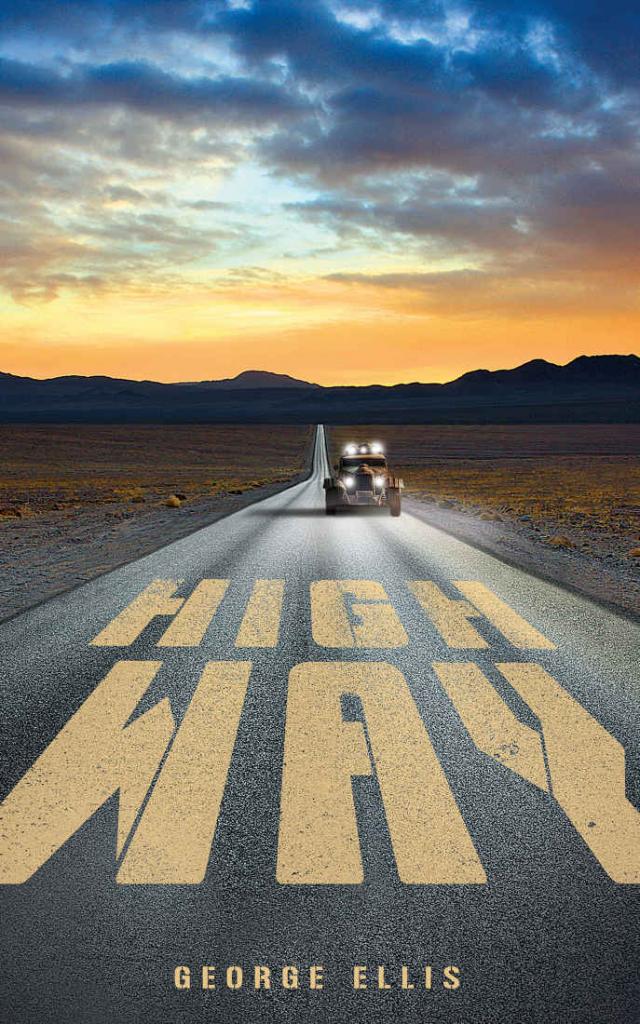


George Ellis
Highway
First published by Zero Atmo Publishing 2023
Copyright © 2023 by George Ellis
All rights reserved. No part of this publication may be reproduced, stored or transmitted in any form or by any means, electronic, mechanical, photocopying, recording, scanning, or otherwise without written permission from the publisher. It is illegal to copy this book, post it to a website, or distribute it by any other means without permission.
This novel is entirely a work of fiction. The names, characters and incidents portrayed in it are the work of the author's imagination. Any resemblance to actual persons, living or dead, events or localities is entirely coincidental.
George Ellis asserts the moral right to be identified as the author of this work.
First edition
ISBN: 978-1-7364843-9-5
Cover art by Rob Story
This book was professionally typeset on Reedsy
Find out more at reedsy.com
Contents
Map Of The Realm
Chapter 1
Chapter 2
We Are the Blade
Chapter 3
Chapter 4
Rich Idiots
Chapter 5
Hill Country
Chapter 6
Chapter 7
The Ballad of Old Bison
Chapter 8
Chapter 9
Monarchy
Chapter 10
Chapter 11
Beyond the Law
Chapter 12
Chapter 13
Chapter 14
The Stranger
Chapter 15
Chapter 16
Moon Shadow
Chapter 17
Chapter 18
Disposition
Chapter 19
Rust Stretch
Chapter 20
Chapter 21
Chapter 22
An Independent Entity
Chapter 23
Tides of Terror
Chapter 24
The Invention That Will Change Everything
Chapter 25
Chapter 26
Where Fortune Teems
Chapter 27
Chapter 28
You Are Not Alone!
Chapter 29
Chapter 30
Oh Ho, the Gulls
Chapter 31
Unmasking the Tyranny
Chapter 32
Chapter 33
Chapter 34
Direct Representation
Chapter 35
Chapter 36
Chapter 37
Epilogue
About the Author
Also by George Ellis
Map Of The Realm
We all travel the same road.
It is our journeys that differ.
Chapter 1
Everything in the world, good or bad, flowed from the Highway beneath Kosta’s sandals. Here, civilization’s main artery was just ten feet across, barely wide enough for two carriages to pass each other in opposite directions. Thousands of sun phases away, the same Highway was a bustling, sixteen-lane thoroughfare lined with steel structures that reached into the clouds.
Or so the stories went.
Kosta removed a sharp bit of gravel from his sole and flicked it into the dirt that lined this particularly remote stretch of the Highway. No cloud-piercing buildings here. A few cacti, sure. Some snakes. Maybe even a red-tailed scorpion. But nothing he hadn’t seen before in his twenty-two years under the sky. Soon, that would change. Both midday suns beat down on Kosta, baking his thick black hair. He wiped the sweat from his dark brow. He just needed to make it to Jourson before nightfall, he told himself. There, he could find a suitable horse to get him through Hill Country and eventually Forest Pass. After that, the Black Sea. And then …
He was getting ahead of himself, again; he could hear his father scolding him for thinking ten paces ahead, only to trip on the stick right in front of his feet. While it was true Kosta had never even been to Jourson, let alone outside The Bonnies, he was exhilarated to be venturing east toward the great Capital City. He tried not to think of the thousand sun phases that separated him from his ultimate destination. His hand moved to a pocket as he considered the most daring aspect of his scheme: how he planned to make it home again.
Focus on your next step, he reminded himself. As he looked down at his worn sandals, he realized he’d need better shoes for the many steps that followed. His hope was to stretch the pair of silver talents hidden in the fabric of his undershirt to cover at least half the trip, then find work along the way as a mechanic for the remainder of the cost. And he was a damn good mechanic. He may have grown up about as far from Capital City as a person could, in a town most people along the Highway had never heard of, but he knew his worth as an engineer. Had he been born in the East, and not The Bonnies, his mind would’ve propelled him to a top university, or directly into the service of an established company. Instead, he’d spent his youth fixing carriages, engines, and all manner of trinkets for shims and coppers. Most of what he earned went to help put food on the table for his two younger brothers and his sister. The rest he stashed away in secret, saving up a small fortune by his family’s standards—two silver talents’ worth after a decade of daily labor.
Kosta’s father, Demetri, was a builder. In a poor, flat land like The Bonnies, that meant constructing shanties and small homes for low pay. When Kosta was a boy, he admired his father’s work ethic. The man set out each day at First Sun’s dawn and rarely returned before nightfall a full eighteen hours later. It was only when Kosta grew old enough to recognize the smell of alcohol and the stupor of drunkenness that he learned the full truth of the matter. Demetri was not a violent man, just a broken one. While he didn’t possess his son’s inherent abilities, Kosta always felt his dad could’ve done more. Been more. Provided more. The Nomikos family was stuck at the edge of civilization, and that would never change, unless Kosta was the catalyst. His younger brother Sam’s illness was just the emergency that pushed Kosta out the door, but he’d been wanting to leave Sunstone, his hometown, for as long as he could remember.
“Curious,” his father had deadpanned, upon hearing Kosta’s intentions. “You say you’ve wanted to travel the Highway to a better place all your life, yet this is the first we hear of it. Now, instead of losing one son, your mother will lose two because of your foolishness.”
Kosta saw a swirl of dust kick up a few hundred feet behind him. An engine, coming his way. He stepped off the Highway and removed a knife from his belt holster. Kosta peered through the sand-riddled wind as the engine approached. It was a piecejob, cobbled together from various parts of other engines that came before it. A two-seater with a rusty, long front end and a cracked glass shield. Kosta could tell from the rumble that the vehicle was a mess under the hood, held together with glue and poor workmanship.
Kosta had been on the Highway for a few days, but he still felt pangs in his stomach every time he crossed paths with someone. With only a blade to protect himself, he was keenly aware of just how alone and vulnerable he was outside the safety of Sunstone. Nobody knew him here, and nobody would come looking for him if he disappeared. Kosta was ready to wait for the engine to pass, trying to appear unconcerned. Instead of rolling by, the engine slowed down and stopped about ten feet from him. The motor rattled and hissed, assaulting Kosta’s ears.
The driver was a large man with wild, dirty hair. A burning tobacco pipe stuck out the corner of his mouth, which curled up into a grin.
“Hot day for a walk!” the man yelled over the motor noise, unbothered by the knife in Kosta’s hand. “Still another few hours to Jourson if that’s where you’re headed. Might not make it before nightfall.”
The man wasn’t wrong. If Kosta was still on the Highway after the suns went down, a new set of worries would present themselves, sharp teeth and claws included. The past two nights, he’d been closer to Sunstone, but now he was in the middle of the flatlands.
“I’ll be fine,” Kosta said, trying to convince the other man and himself at the same time.
“Didn’t mean to imply you wouldn’t,” the man said. “Only I can’t help but notice those sandals. Peculiar footwear for a traveler.”
Kosta peered at him, trying to determine his game.
“Everybody calls me Piney,” the man said, cutting the motor.
“Where are you coming from?”
“I suspect from the same place you did. Sunstone. Nothing else back that way but The Sands, and you don’t strike me as a dune warrior kinda fella, that knife notwithstanding. I mean no harm, by the way. Just like meeting new folks is all. My mom always said my problem was that I was too darn friendly for this world. She also didn’t like my choice of politics, but that’s too long a story for someone standing in the heat. I do like an interesting trade, though.”
“I don’t have anything I’m looking to trade at the moment, but I thank you for the offer.” Kosta turned and started to walk east.
Piney unlatched the passenger door of the open-topped engine. “Maybe you just aren’t thinking hard enough.”
“My mom would say that’s never been my problem.”
Piney laughed so hard he nearly spit out his pipe. “I like you! Nice to meet a sharp mind on the Highway. You sure you got nothing to trade for a ride? I’d hate to see a smart kid like you trying to fend off the night wolves with a bitty sword like that. Wolves don’t care how intelligent you are, just how you taste.”
“There mig ht be one thing I could trade,” Kosta said.
A half hour later, Kosta sat in the passenger side of Piney’s engine, resting his aching legs. Piney was still shaking his head in disbelief.
“You’re a damn sorcerer,” he said. “It’s like a whole new motor! I can’t even hear that high-pitched screeching anymore.”
Or the rattle and thunks, Kosta thought. The motor was far from ideal, but it was in acceptable working order after he’d spent some time attaching hoses to their proper places, adjusting the valve timing, and cleaning the intake. It always amazed Kosta that other people didn’t realize how easily their engines could be improved with a little know-how. Still, Piney was impressed. In addition to the ride to Jourson, the big man shared some rabbit jerky he’d picked up a few weeks earlier.
“Been as far as Bargetown,” Piney said pridefully. “Yep. Three times. From Bargetown to The Sands, back and forth. This’ll be my fourth trip.”
Kosta glanced over at Piney, who looked the part: a loner with a wizened face and mismatched clothes. “Why?” Kosta asked.
“Why what?”
“Why do you travel back and forth on the Highway?”
Piney regarded Kosta as if he was crazy. “The question you should be asking is why not. If we’re all supposed to stay in our corners of the world, why is the world so damn big? I’d give my right arm to be your age all over again, venturing out for the first time.”
“Who said it’s my first time?”
Piney didn’t bother responding to that. He just puffed on his pipe and watched the suns starting to set on the edge of the horizon. Kosta felt foolish for trying to pretend he wasn’t new at this traveling thing. “What’s Bargetown like?”
“Unsteady,” Piney said, barking out a laugh. “I mean that in the literal sense; it’s an entire city made of floating barges on a river. But I’m talking about the way it feels. Always moving and changing. You can find anything and everything you want there, including trouble. It’s a shame too, because it’s the closest thing to Balance I’ve seen. Nobody owns any property in Bargetown, not really.”
Balance. Kosta wasn’t entirely surprised to learn Piney was a Liberalist. He seemed cheery enough to believe the world belonged to everyone equally. A nice notion in theory, but untenable in practice, if you asked Kosta. He favored more of a merit-based model: you get what you earn. Simple. Fair. Sure, people should be taken care of in general if they can’t do it for themselves, but the idea that class distinctions would ever not exist, well, that was pure folly.
“All in all, not my favorite place, Bargetown,” Piney said. “Reminds me of what could’ve been, but definitely ain’t.”
Having grown up in the arid flatlands of The Bonnies, surrounded by sun-scorched terrain, Kosta tried to imagine thousands of floating barges packed so tightly together they formed a landmass over a river. He’d heard stories about the barge markets, where you could buy or trade for anything. He’d also heard about the thieves and slavers that roamed the floating city, seeking out inexperienced travelers like him.
“If you’ve been to Bargetown three times, why haven’t you ever crossed the river?” Kosta asked.
Piney shifted the engine to a higher gear, and the motor cooperated with a smooth purr. He squinted at Kosta in surprise. “You could make a lot of money with those hands.”
“So you said.”
“I stop at Bargetown because that other place, the one next to it, that ain’t for me,” he said. “Is that where you’re headed?”
Kosta didn’t answer. He was already the furthest he’d ever been from home, and he was going much further. Bargetown wasn’t even half as far as he planned to travel.
“Jourson,” Piney said, motioning to the lights that twinkled against the darkening night sky. Somewhere behind them, a lone wolf howled. “Guess it’s a good thing you didn’t walk.”
Chapter 2
King Stanley York sipped his morning coffee and gazed at the city a thousand feet below the royal suite. All those people scurrying about like ants in the shadow of the conical structure that housed both the city parliament and the imperial residence. It was his job to care for those ants. To rule them. To decide when they needed love and when they needed rules.
Ugh, the coffee is bitter.
That was the second time this week. York reminded himself to have the kitchenmaster replaced. He set the cup on the table beside him and turned to face Phinnaeus Fallroy, the portly prime minister, who waited silently for the king’s decision. The man has let himself go, York thought. When he first appointed Fallroy to the top political post in Capital City, the noble-born heir to a construction fortune had been lean and sharp. He impressed York with a quick wit and calculating demeanor. Fallroy wasn’t cowed by the throne like the previous prime minister, a sniveling woman who mercifully died of a blood infection before York had to take matters into his own hands for the good of the kingdom. Now, Fallroy reminded the king of his ineffectual predecessor; he sagged from the weight of too many royal dinners, his body and mind dulled by the benefits of being seen as the king’s right hand.
“I’m inclined to allocate the funds elsewhere,” York said, catching his own reflection in the mirrored wall. Compared to Fallroy, he was the picture of health: slender, good posture, unblemished olive skin. With his curly hair and disarming smile, he could easily pass for ten years younger. By all appearances, he was still in his prime. But York knew something wasn’t right with his body. It had been failing him in strange ways of late; he was prone to shortness of breath and dizzy spells, his chest ached in the morning, and food often tasted sour or, like the coffee, bitter.
Fallroy nodded. “A wise inclination, Your Highness. I shall relay your wishes at once.”
York had expected more of a fight from Fallroy, if only out of self-interest. Despite his official role, Fallroy still ran the kingdom’s largest construction company, and it would no doubt receive the lion’s share of the contracts to repair the stretch of the Highway that linked Capital City to the edge of Hawk’s Wing.
Curious.
“You don’t think we should prioritize the repairs?” the king asked.
“Far be it from me to question your instincts on the matter,” Fallroy replied.
York tensed his jaw. What he wouldn’t give to have the young Fallroy back. But such was the nature of prime ministers, he’d found. A pity. “Humor me, Phinnaeus, with a counterpoint,” York pressed, if only for sport. “Pretend your spine is still functional.”
Fallroy bristled slightly at the insult; he did his best to hide the flash of anger in his eyes, but York caught it.
Signs of life, the king thought.
“As ever, many citizens equate the greatness of the kingdom with the greatness of the Highway, especially our stretch of it,” Fallroy said. “Cracks and potholes may be perfectly fine for the Sprawl. Nor do the people care about rumors of the Highway being no more than a dirt path on the other side of the Black Sea. But so near the capital, it’s a sign of weakness.”
Fallroy wasn’t wrong. The people liked perfection. In their institutions, their leaders, and their beloved road. Fallroy didn’t need to remind York of King Leonor, who had spent his entire reign ignoring structural repairs to the Highway, instead draining the imperial coffers to throw lavish exhibitions and parties in the capital, year after year, until he was finally dragged through the streets, his mangled body dumped next to a crumbled overpass. The message was clear: ignore the Highway at your own peril.
“I shall think on it,” York said. “What about the marriage backlash?”
“What about it?”
“Should we rein in the Inquisitors? It all seems a bit regressive to me. Punishing people for marrying above their station? Are we not beyond that?”
Fallroy placated the king with a momentary pause before responding, as if to suggest he hadn’t planned his rebuttal. “Homeostasis is underrated. Today a street merchant marries a socialite, tomorrow the people want a commoner for their king. Best to keep things as they are and not risk what they might become.”
“The moment you fear change is the moment it’s too late,” York said. “Besides, I often wonder if a commoner might do well as a monarch. Certainly, they would understand their people better. Express my concerns to the Center of Justice regarding the marriage punishments. There’s no better way to make an enemy of a man than to deny him what his heart desires.”






