

Far futures, p.1
Far Futures, page 1


Jerry eBooks
No copyright 2018 by Jerry eBooks
No rights reserved. All parts of this book may be reproduced in any form and by any means for any purpose without any prior written consent of anyone.
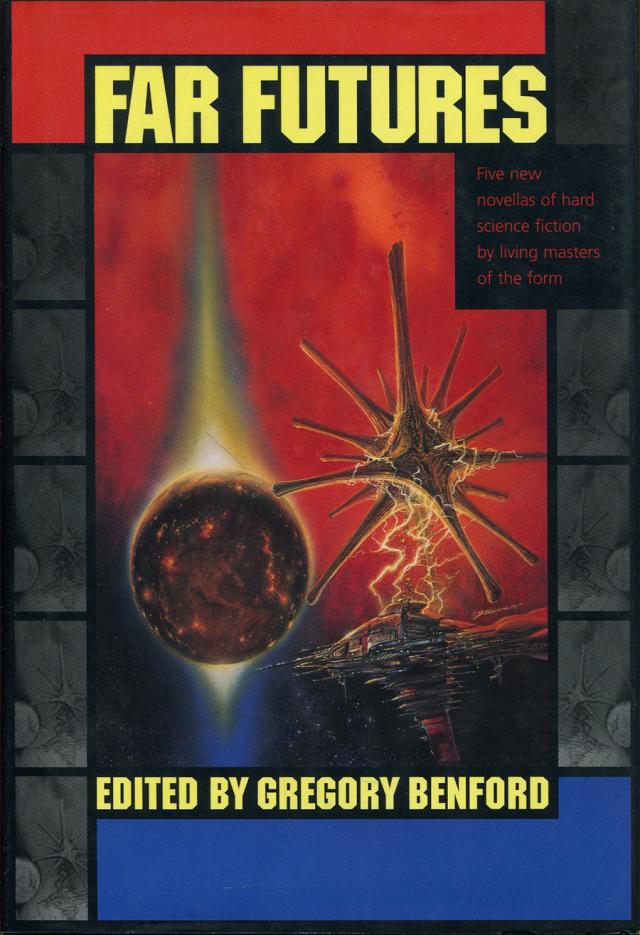
Gregory Benford, of the greatest SF writers of our day, has assumed the mantle of editor to produce an ambitious hard SF anthology: Far Futures. Many of the field's greatest works concern vast perspectives, expanding our visions of ourselves by foreseeing the immense panorama of time. This anthology collects five original novellas that take the very long view, all set at least ten thousand years in the future. The authors take a rigorously scientific view of such grand panoramas, confronting the largest issues of cosmology, astronomy, evolution, and biology.
The new tales are:
Genesis by Poul Anderson is set a billion years ahead, when humanity has become extinct. Earth is threatened by the slowly warming sun. Vast machine intelligences decide to recreate humans.
In At the Eschaton by Charles Sheffield, a man tries to rescue his dying wife from oblivion by hurling himself forward, in both space and time, to the very end of the universe itself.
Joe Haldeman's For White Hill confronts humanity with hostile aliens who remorselessly grind down every defense against them. A lone artist struggles to find a place in this distant, wondrous future, where humanity seems doomed.
The last moments of a universe besieged occupy Greg Bear's Judgment Engine. Can something human matter at the very end of creation, as contorted matter ceases to have meaning and time itself stutters to an eerie halt?
Donald Kingsbury contributes Historical Crisis, a startling work on the prediction of the human future that challenges the foundations of psychohistory, as developed in Isaac Asimov's famous Foundation Trilogy.
Far Futures is required reading for the core audience of hard SF devotees. It may be the best book they read all year.
GREGORY BENFORD lives in
Laguna Beach, California.
This is a work of fiction. All the characters and events portrayed in this book are either fictitious or are used fictitiously.
FAR FUTURES
Copyright © 1995 by Gregory Benford
All rights reserved, including the right to reproduce this or portions thereof, in any form.
This book is printed on acid-free paper.
Edited by David G. Hartwell
A Tor Book
Published by Tom Doherty Associates, Inc.
175 Fifth Avenue
New York, N.Y. 10010
Tor Books on the World-Wide Web:
http://www.tor.com
Tor® is a registered trademark of Tom Doherty Associates, Inc.
ISBN 0-312-85639-3 (hardcover)
Printed in the United States of America
CONTENTS
Introduction: Looking Long Gregory Benford
Judgment Engine Greg Bear
Genesis Poul Anderson
Historical Crisis Donald Kingsbury
For White Hill Joe Haldeman
At the Eschaton Charles Sheffield
COPYRIGHT
ACKNOWLEDGMENTS
“Judgment Engine” copyright © 1995 by Greg Bear
“Genesis” copyright © 1995 by The Trigonier Trust
“Historical Crisis” copyright © 1995 by Donald Kingsbury
“For White Hill” copyright © 1995 by Joe Haldeman
“At the Eschaton” copyright © 1995 by Kirkwood Research, Inc.
For Arthur C. Clarke
INTRODUCTION
LOOKING LONG
LITTLE SCIENCE FICTION deals with truly grand perspectives in time. Most stories and novels envision people much like ourselves, immersed in cultures that quite resemble ours, and inhabiting worlds that are foreseeable extensions of places we now know. Such landscapes are, of course, easier to envision, more comfortable to the reader, and simpler for the writer; one can simply mention everyday objects, letting them set the interior stage in the readers mind.
Yet some of our field’s greatest works concern vast perspectives in time, eerie landscapes and epochs. Most of Olaf Stapledon’s novels (Star Maker, Last and First Men) are set against such immense backdrops. Arthur Clarke’s Against the Fall of Night opens over a billion years in our future. These works have remained in print many decades, partly because they are rare attempts to “look long”—to see ourselves against the scale of evolution itself.
Indeed, H.G. Wells wrote The Time Machine in part as a reaction to the Darwinian ideas that had swept the intellectual world of comfortable England. He conflated evolution with a Marxist imagery of racial class separation, notions that could only play out on the scale of millions of years. His doomed crab scuttling on a reddened beach was the first great image of the far future.
Similarly, Stapledon and the young Clarke wrote in the dawn of modem cosmology, shortly after Hubble’s discovery of universal expansion implied a startlingly large age of the universe. Cosmologists then believed this to be about two billion years. From better measurements, we now think it to be at least five times that. In any case, it was so enormous a time that pretensions of human importance seemed grotesque, even laughable. We have been around less than a thousandth of the universe’s age. Much has gone before us, and even more will follow.
In recent decades there have been conspicuously few attempts to approach such perspectives in literature. This is curious, for such dimensions afford sweeping vistas, genuine awe. Probably most writers find the severe demands too daunting. One must understand biological evolution, the physical sciences, and much else—all the while shaping a moving human story, which may not even involve humans as we now know them. Yet there is a continuing audience for such towering perspectives.
This anthology collects original novellas that directly attack the very long view. In commissioning these works, I set a boundary of at least a thousand years in our future, while encouraging the authors to venture much further—a billion years was quite all right.
Further, the authors have taken a rigorously scientific view of such grand panoramas, for they are all from the “hard”-science-fiction community. You’ll find no fin de siecle, “bored parties at the end of time” narratives here, no lurid “super science” that rings hollow. But they are not narrow in focus, either. These stories are scientifically plausible and address the very largest issues that arise from our modem knowledge of cosmology, astronomy, evolution and biology. “Thinking long” means “thinking big.”
We are tied to time, immense stretches of it. Our DNA differs from that of chimps by only 1.6 percent, a point lovingly detailed in Jared Diamond’s The Third Chimpanzee. We are a hairsbreadth from die jungle, a third variety of chimp. A zoologist from Alpha Centauri would classify us without hesitation along with the common chimp of tropical Africa and the pygmy chimp of Zaire. Most of that 1.6 percent may well be junk, too, of no genetic importance, so the significant differences are even smaller.
We carry genetic baggage from far back in lost time. We diverged genetically from the Old World monkeys about thirty million years ago, from gorillas about ten million years ago, and from the other chimps about seven million years ago. Only forty thousand years ago did we appear—if one means our present form, which differs in shape and style greatly from our ancestor Neanderthals. We roved farther, made finer tools, and when we moved into Neanderthal territory, the outcome was clear; within a short while, no more Neanderthals.
No other large animal is native to all continents and breeds in all habitats, from rain forests to deserts to the poles. Among the unique abilities that we proudly believe led to our success, we seldom credit our propensity to kill each other and our habit of destroying our environment—yet there are evolutionary arguments that these were valuable to us once, leading to pruning of our genes and ready use of resources.
These same traits now threaten our existence. They also imply that, if we last into the far future, those deep elements in us will make for high drama, rueful laughter, triumph and tragedy.
While we have surely been shaped by our environment, our escape from bondage to our natural world is the great theme of civilization. How will this play out on the immense scale of many millennia? The environment will surely change, both locally on the surface of the Earth, and among the heavens. We shall change with it.
We shall probably meet competition from other worlds, and may fall from competition to a Darwinian doom, as Joe Haldeman depicts in his novella. Nature plays no favorites. We could erect immense empires and play Godlike with vast populations, as Donald Kingsbury explores. And surely we could tinker with the universe in ingenious ways, the inquisitive chimpanzee wrestling whole worlds to suit his desires.
Once we gain great powers, we can confront challenges undreamed of by Darwin. The universe as a whole is our ultimate opponent.
In the very long run, the astrologers may turn out to be right: our fates may be determined by the stars. For they are doomed.
Stars are immense reservoirs of energy, dissipating their energy stores into light as quickly as their bulk allows. Our own star is 4.5 billion years old, almost halfway through its eleven-billion-year life span. After its benign era, it shall begin to bum heavier and heavier elements at its core, growing hotter. Its atmospheric envelope of already incandescent gas shall heat and swell. From a mild-mannered, yellow-white star it shall bloat into a reddened giant, swallowing first Mercury, then Venus, then Earth and perhaps Mars. H. G. Wells foresaw in The Time Machine a dim sun, with a giant crablike thing scuttling across a barren beach . While evocative, this isn’t what astrophysics now tells us. But as imagery, it remains a striking reflection upon the deep problem that the far future holds—the eventual meaning of human action.
About 4.5 billion years from now, our sun will rage a hundred times brighter. Half a billion years further on, it will be between five hundred and a thousand times more luminous, and seventy percent larger in radius. The Earth’s temperature depends only weakly on the sun’s luminosity (varying as the one-fourth root), so by then our crust will roast at about 1,400 degrees Kelvin; room temperature is 300 Kelvin.
The oceans and air will have boiled away, leaving barren plains beneath an angry sun that covers thirty-five degrees of the sky.
What might humanity—however transformed by natural selection, or by its own hand—do to save itself? Sitting farther from the fire might work. Temperature drops inversely with the square of distance, so Jupiter will be cooler by a factor of 2.3, Saturn by 3.1. But for a sun five hundred times more luminous than now, the Jovian moons will still be 600 degrees Kelvin (K), and Saturn’s about 450 K. Uranus might work, 4.4 times cooler, a warm but reasonable 320 K. Neptune will be a brisk 255 K. What strange lives could transpire in the warmed, deep atmospheres of those gas giants?
Still, such havens will not last. When the sun begins helium burning in earnest, it will fall in luminosity, and Uranus will become a chilly 200 K. Moving inward to Saturn would work, for it will then be at 300 K, balmy shirtsleeve weather—if we have arms by then.
The bumpy slide downhill for our star will see the sun’s luminosity fall to merely a hundred times the present value, when helium burning begins, and the Earth will simmer at 900 K. After another fifty million years—how loftily astrophysicists can toss off these immensities!—as further reactions alter in the sun’s core, it will swell into a red giant again. It will blow off its outer layers, unmasking the dense, brilliant core that will evolve into a white dwarf. Earth will be seared by the torrent of escaping gas, and bathed in piercing ultraviolet light. The white-hot core will then cool slowly.
As the sun eventually simmers down, it will sink to a hundredth of its present luminosity. Then even Mercury will be a frigid 160 K, and Earth will be a frozen corpse at 100 K. The solar system, once a grand stage, will be a black relic beside a guttering campfire.
To avoid this fate, intelligent life can tinker—at least for a while— with stellar burning. Our star will get into trouble because it will eventually pollute its core with the heavier elements that come from burning hydrogen. In a complex cycle, hydrogen fuses and leaves assorted helium, lithium, carbon, and other elements. With all its hydrogen burned up at its core, where pressures and temperatures are highest, the sun will begin fusing helium. This takes higher temperatures, which the star attains by compressing under gravity. Soon the helium runs out. The next heavier element fuses. Carbon bums until the star enters a complex, unstable regime leading to swelling. (For other stars than ours, there could even be explosions [supernovas] if their mass is great enough.)
To stave off this fate, a cosmic engineer need only note that at least ninety percent of the hydrogen in the star is still unburned when the cycle turns in desperation to fusing helium. The star’s oven lies at the core, and hydrogen is too light to sink down into it.
Envision a great spoon that can stir the elements in a star, mixing hydrogen into the nuclear ash at the core. The star could then return to its calmer, hydrogen-fusing reaction.
No spoon of matter could possibly survive the immense temperatures there, of course. But magnetic fields can move mass through their rubbery pressures. The sun’s surface displays this, with its magnetic arches and loops that stretch for thousands of kilometers, tightly clasping hot plasma into tubes and strands.
If a huge magnetic paddle could reach down into the sun’s core and stir it, the solar life span could extend to perhaps a hundred billion years. To do this requires immense currents, circulating over coils larger than the sun itself.
What “wires” could support such currents, and what battery would drive them? Such cosmic engineering is beyond our practical comprehension, but it violates no physical laws. Perhaps, with five billion years to plan, we can figure a way to do it. In return, we would extend the lifetime of our planet tenfold.
To fully use this extended stellar lifetime, we would need strategies for capturing more sunlight than a planet can. Freeman Dyson envisioned breaking up worlds into small asteroids, each orbiting its star in a shell of many billions of small worldlets. These could in principle capture nearly all the sunlight. We could conceivably do this to the Earth, then the rest of the planets.
Of course, the environmental impact report for such engineering would be rather hefty. This raises the entire problem of what happens to the Earth while all these stellar agonies go on. Even if we insure a mild, sunny climate, there are long-term troubles with our atmosphere.
Current thinking holds that the big, long-term problem we face is loss of carbon dioxide from our air. This gas, the food of the plants, gets locked up in rocks. Photosynthetic organisms down at the very base of the food chain extract carbon from air, cutting the life chain.
We might fix this by bioengineering organisms that return carbon dioxide. Then we would need to worry about the slow brightening of our sun, which would make our surface temperature about 80 degrees Centigrade in 1.5 billion years. Compensating for this by increasing our cloud cover, say, would work for a while. Poul Anderson sets his novella on an Earth cloud-shrouded and warming, heading for trouble.
A cloud blanket will work for a while. Still, we continually lose hydrogen to space, evaporated away at the top of the atmosphere. Putting water clouds up to block the sunlight means that they, too, will get boiled away. Even with such measures, liquid water on Earth would evaporate in about 2.5 billion years. Without oceans, volcanoes would be the major source for new atmospheric elements, and we would evolve a climate much like that of Venus.
All this assumes that we don’t find wholly new ways of getting around planetary problems. I suspect that we crafty chimpanzees probably shall, though. We like to tinker and we like to roam. Though some will stay to fiddle with the Earth, the sun, and the planets, some will move elsewhere.
After all, smaller stars will live longer. The class called M dwarfs, dim and red and numerous, can bum steady and wan, for up to a hundred billion years, without any assistance. Then even they will gutter out. Planets around such stars will have a hard time supporting life, because any world close enough to the star to stay warm will also be tide-locked, one side baked and the other freezing. Still, they might provide temporary abodes for wandering primates, or for others.
Eventually, no matter what stellar engine we harness, all the hydrogen gets burned. Similar pollution problems beset even the artificially aged star, now completely starved of hydrogen. It seethes, grows hotter, sears its planets, then swallows them.
There may be other adroit dodges available to advanced life-forms, such as using the energy of supernovas. These are brute mechanisms, and later exploding stars can replenish the interstellar clouds of dust and gas, so that new stars can form—but not many. On average, matter gets recycled in about four billion years in our galaxy. Our own planet’s mass is partly recycled stellar debris from the first galactic supernova generation. This cycle can go on until about twenty billion years pass, when only a ten-thousandth of the interstellar medium will remain. Dim red stars will glow in the spiral arms, but the great dust banks will have been trapped into stellar corpses.
So unavoidably, the stars are as mortal as we. They take longer, but they die.
For its first fifty billion years, the universe will brim with light. Gas and dust will still fold into fresh suns. For an equal span the stars would linger. Beside reddening suns, planetary life will warm itself by the waning fires that herald stellar death.
Sheltering closer and closer to stellar warmth, life could take apart whole solar systems, galaxies, even the entire Virgo cluster of galaxies, all to capture light. In the long run, life must take everything apart and use it, to survive.






