

The midnight house, p.1
The Midnight House, page 1


Copyright © 2022 Amanda Geard
The right of Amanda Geard to be identified as the Author of
the Work has been asserted by her in accordance with the
Copyright, Designs and Patents Act 1988.
First published in Great Britain in 2022 by
HEADLINE REVIEW
An imprint of HEADLINE PUBLISHING GROUP
First published as an Ebook in 2022 by
HEADLINE REVIEW
An imprint of HEADLINE PUBLISHING GROUP
Apart from any use permitted under UK copyright law, this publication may
only be reproduced, stored, or transmitted, in any form, or by any means,
with prior permission in writing of the publishers or, in the case of
reprographic production, in accordance with the terms of licences
issued by the Copyright Licensing Agency.
All characters in this publication are fictitious and any resemblance
to real persons, living or dead, is purely coincidental.
Cataloguing in Publication Data is available from the British Library
ISBN: 978 1 4722 8372 6
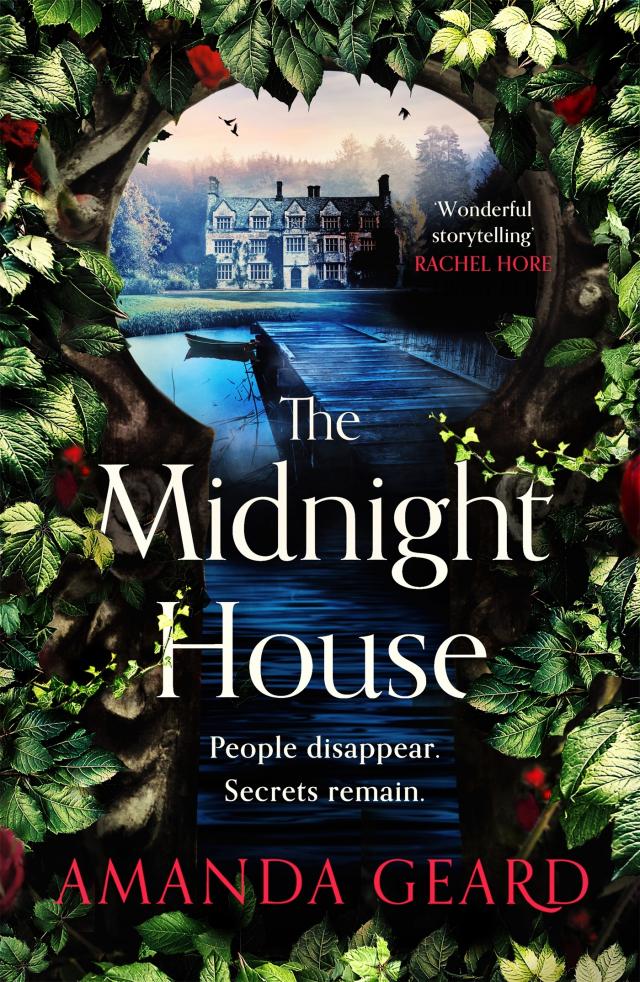
Cover images: Keyhole frame © Drunaa/Trevillion Images;
lake and jetty © Patryk_Kosmider/Deposit Photos;
all other imagery © Shutterstock
Cover design by Siobhan Hooper
Author Photograph © Barry Stoffell
HEADLINE PUBLISHING GROUP
An Hachette UK Company
Carmelite House
50 Victoria Embankment
London EC4Y 0DZ
www.headline.co.uk
www.hachette.co.uk
Contents
Title
Copyright
About the Author
Praise
About the Book
Dedication
Epigraph
Family Tree
Prologue
Chapter One
Chapter Two
Chapter Three
Chapter Four
Chapter Five
Chapter Six
Chapter Seven
Chapter Eight
Chapter Nine
Chapter Ten
Chapter Eleven
Chapter Twelve
Chapter Thirteen
Chapter Fourteen
Chapter Fifteen
Chapter Sixteen
Chapter Seventeen
Chapter Eighteen
Chapter Nineteen
Chapter Twenty
Chapter Twenty-One
Chapter Twenty-Two
Chapter Twenty-Three
Chapter Twenty-Four
Chapter Twenty-Five
Chapter Twenty-Six
Chapter Twenty-Seven
Chapter Twenty-Eight
Chapter Twenty-Nine
Chapter Thirty
Chapter Thirty-One
Chapter Thirty-Two
Chapter Thirty-Three
Chapter Thirty-Four
Chapter Thirty-Five
Chapter Thirty-Six
Chapter Thirty-Seven
Chapter Thirty-Eight
Chapter Thirty-Nine
Chapter Forty
Chapter Forty-One
Chapter Forty-Two
Chapter Forty-Three
Chapter Forty-Four
Chapter Forty-Five
Chapter Forty-Six
Chapter Forty-Seven
Chapter Forty-Eight
Chapter Forty-Nine
Chapter Fifty
Chapter Fifty-One
Chapter Fifty-Two
Chapter Fifty-Three
Chapter Fifty-Four
Chapter Fifty-Five
Chapter Fifty-Six
Chapter Fifty-Seven
Chapter Fifty-Eight
Epilogue
Author’s Note
Acknowledgements
About the Author
Born in Australia, Amanda Geard has lived all over the world, from a houseboat in London to a Norwegian Island, before settling in County Kerry in Ireland. Her writing has appeared in The Irish Times, The Journal, writing.ie, Nordic Reach and Vertical Magazine. Her short story Not Yet Recycled won the New Irish Writing Award in October 2019.
The Midnight House is Amanda’s debut novel.
Praise for The Midnight House:
‘Amanda Geard is a warm and lively new voice and has a wonderful storytelling talent. I loved The Midnight House’
Rachel Hore
‘An intriguing story with wonderful characters in a beautiful setting. I loved it’
Rachael English
‘A wonderful debut. I loved it! Three timelines deftly handled, layers of mysteries unfolding cleverly and beautiful writing. Most excellent!’
Tracy Rees
‘I was pulled in from page one. It’s beautiful and I love it’
Liz Fenwick
‘With its gorgeous setting, wonderful characters and secrets that kept me glued to the pages, it’s a beauty!’
Jenny Ashcroft
‘Intriguing, moving and I loved the way the stories moved back and forth in time. A lovely book’
Sinéad Moriarty
‘Compelling and brimming with lush historical detail, The Midnight House weaves a wonderful tale of family secrets and female friendship, told over eight decades. Amanda Geard is an exciting new voice in fiction’
Hazel Gaynor
‘I really, really loved it. It was so refreshing but also written in that old-school, descriptively beautiful way I adore. Totally atmospheric and wonderfully escapist’
Lorna Cook
‘A gorgeous book. I loved it’
Emma Curtis
About the Book
My Dearest T, Whatever you hear, do not believe it for a moment . . .
1940
In south-west Ireland, the young and beautiful Lady Charlotte Rathmore is pronounced dead after she disappears by the inky lake of Blackwater Hall. In London, on the brink of the Blitz, Nancy Rathmore is grieving Charlotte’s death when a letter arrives containing a shocking secret that Nancy is sworn to keep – one that will change her life for ever.
1958
Growing up at the mysterious Blackwater Hall, Nancy’s daughter Hattie finds that nothing above or below stairs is quite as it seems and what she discovers she can never forget.
2019
Journalist Ellie Fitzgerald leaves Dublin and flees to Kerry to escape a scandal. But when she uncovers a faded letter, tucked inside the pages of an old book, she finds herself drawn in by a long-buried mystery. And she realises the letter might hold the key to more than just Lady Charlotte’s disappearance.
To Mum, with love
The truth, however ugly in itself, is always curious and beautiful to the seeker after it.
Agatha Christie, The Murder of Roger Ackroyd
Have the hindsight to know
Where you did go,
And the foresight to look where you’re going.
Have the insight to see
Where you will be,
And if you’re too far along, stop rowing.
Tabby Ryan, ‘The Hundred-Year-Old Poet’
Prologue
The house, it’s said, was once a great ringfort, piled purple stones placed with such precision that its smooth wall – a perfect circle – rose from the earth without a sliver of mortar to hold it together. It saw the arrival of the Bronze Age. The passing of the Iron Age. The coming of Christianity to this emerald isle on the edge of the tumbling Atlantic Ocean.
Its stones – they say – were moved, one by one, by rough tenant hands, into a new shape, a rectangle, all evidence of curving geometry lost. More stones were added, taken from the base of the mountain that towers behind. And cool blue slate – at dawn it turns to warm magenta – was brought from Valentia Island, where it was cleft in neat regular slivers, its smooth scales forming a weatherproof skin, the veins lined with lead.
To delay decay, local timber was shunned. Even beams made from the slow-grown oaks of Ireland’s woodlands could not compete with rich resinous pitch pine shipped across the ocean. The walls – held together with mortar, unlike the fort from which they are said to have been pulled – were given a sheath: alkaline powder mixed with the inky waters of the lough.
Even back then, ivy crept from the wooded surrounds, reaching eagerly towards the new walls with curious fingers. The gardeners would cut it back, year after year, but still it came.
Once the house was watertight, work on the inside began: green Connemara marble fashioned into fireplaces, quarry tiles imported from a thousand miles east, hand-painted silks unfurled from the Orient. Countless sash windows peered from the elevation like sentinels. They were eyes on the world, and when they blinked, they let in fresh Kerry air rolling damp from the ocean below.
Over the years, the house was added to, extended piece by piece: a wing here, a boiler room there, a hall for the servants at the back. Each postscript tied in by new layers of that blue-then-magenta slate. There were times when the chimneys puffed white peaty smoke. There were times when they didn’t. Generations came and went. Malevolent landlords. Benevolent landlords. Absent landlords. And their children too.
Ireland fought for freedom; the old order tumbled.
And Blackwater Hall survived. But it could yet disappear.
Because ringforts disappear.
Houses disappear.
People disappear.
Chapter One
Ballinn, County Kerry
September 2019
It was the contents of her mum’s bookshelf that finally drove Ellie out of hiding; Moira Fitzgerald’s taste in literature was chalk and cheese to her daughter’s. Heaving bosoms versus timeless classics. And two weeks of plot lines where the guy gets the girl and everything turns out hunky-dory was just too much.
In a desperate bid to fill her days, Ellie had devoured a dozen old editions of The Kerryman scattered here and there about the house, read the crumpled ageing news of local sporting victories and items lost and found. When she’d asked Moira to pick up the Guardian from the village shop, her mum had loyally obliged, bringing the paper back each day between two fingers as though it might be contagious. Ellie knew she would have made some excuse to Deidre O’Brien, the proprietor – and purveyor of gossip – about why she was ordering it (sure, Ellie’s career is flying in Dublin – a freelance article in the Guardian!).
A little white lie.
Now, browsing the shelves in Ballinn’s only charity shop, Ellie admitted to herself it had been a mistake to come out of exile, to wind her way down from the safety of her mum’s farm to the village, where prying eyes and flapping ears were sure to be lying in wait. Her large sunglasses, meant as a disguise, had attracted more attention than they’d diverted, and her mum’s green Nissan Micra, which made a wince-inducing crunch in second gear, drew a friendly wave from every local on Main Street, their hands poised in mid-air as they realised it wasn’t Moira Fitzgerald behind the wheel but someone altogether different.
But still, she’d snuck into Threadbare undetected, and with any luck she could leave a few coins on the counter, tuck some books under her arm and slip out unseen.
‘Eleanor?’
Oh dear.
‘Is that you?’
Ellie looked and saw . . . nothing. No one. The shop was as dead as she felt inside. She added going stir crazy to the long list of things that were wrong with her.
The disembodied voice called again. ‘Ellie?’
She squinted into the gloom. ‘Hello?’
A head appeared. It floated above a shelf of women’s clothing then emerged atop a large body covered shoulders to toes in an amorphous collection of fabrics, a hundred jagged colours stitched together as though they’d been thrown in a blender and pulsed.
‘Bernie?’ Ellie’s shoulders dropped with relief. Bernie was her mum’s best friend and relatively discreet confidante; a rare commodity in Ballinn. ‘Bernie, I . . . if I’d known you were working here, I’d not have crept in . . .’
‘In disguise?’
Ellie removed her huge sunglasses. It had been a ridiculous notion: hiding in plain sight in a rural Irish village.
Bernie stepped forward, a grin on her wide face, and pulled Ellie into a technicolour bear hug. ‘You poor, poor cratúir. Your mammy said you’d be at the homeplace for a bit.’
‘It’s great to see you,’ Ellie said truthfully. ‘It’s good to be back.’ Another little white lie.
She did love Ballinn – it was charming in its way, sandwiched neatly between the heather-flecked foothills of the MacGillycuddy Reeks and the wild Atlantic. It had a church, two pubs, a café whose ownership changed with the seasons, a well-worn charity shop selling well-worn things and a garda station open every second Tuesday. And, of course, a corner shop where gossip was dished out gratis to the few dozen locals – and few hundred holiday-home owners – with every carton of milk. In winter, the village smelled of peat, its earthy smoke mingling with the fog that rolled off Kenmare Bay. In summer, it could be glorious or sodden; some days it cowered under incessant rain thrown from the Gulf Stream, other times it was bathed in sunshine, the square packed with gaggles of delighted tourists buying Irish-wool sweaters and overpriced ice cream. It was beautiful. Quaint. Grand. But it was still coming back. Still the homeplace. Not home, as such. But a safe house. Comfort, familiar surrounds and her mum’s butter-laden cooking.
‘There’s a bit of Dublin in you now,’ said Bernie, holding her at arm’s length. ‘They’ve been starving you up there?’
‘I haven’t been looking after myself.’
‘No. Course you haven’t.’
Ellie wasn’t sure how much Berne knew, but no doubt Moira had given her an overview, titbits of Ellie’s broken life. Or, at least, the titbits her mum knew about. She sighed and stepped back, looked past Bernie to the sheets of rain washing the window pane. But by avoiding Bernie’s gaze, she caught her own, there in the glass, staring back. Her usually neat fringe messy. Her hair an Ozzy Osbourne wig. She wore a black leather jacket and pale jeans: her uniform. And a smear of red lipstick: her armour.
‘. . . and my Sean always said you were top of the class.’
She turned back to Bernie. ‘Sorry?’
‘He considered you his best pupil.’
‘Out of twelve students?’
‘Wilful but bright.’ Bernie nodded. ‘Or . . . not so much bright as curious.’
‘Didn’t curiosity kill the cat?’
Bernie touched her lightly on the shoulder. ‘You’re not dead yet, pet. Far from it.’
But Ellie felt dead. Inside. Outside. She ached with the desire to turn back the clock. Her old job. Her old love. Her old life.
The older woman reached forward and squeezed her hand in a way that said feck ’em, and it took her by surprise. Ellie dropped her eyes, felt a familiar prickle behind them. Pushed it away as she took back her hand. She despised this new weakness inside her, and yet it was there.
Bernie frowned, then turned on her heel. ‘As vice chief volunteer at Threadbare, Ellie, I’m offering you VIP shopping.’ She went to the door, flicked the lock, then waved an arm around the room as though somewhere among the jumble lay the answer to all Ellie’s problems.
Despite herself, Ellie smiled. ‘Vice chief? I thought you’d be the boss.’
‘The chief’d never give up the top spot. Anyway, I can’t think of anything worse.’ Bernie leaned forward conspiratorially. ‘Last week we started block colouring. In a charity shop!’
It was true, a feeble effort had been made. Reds on one rack graduating to pink then off-white. Blues gathered in the back corner. And yellows piled high by the doorway as though attempting an escape.
Bernie took a scarlet shirt and moved it across to the greys with a nod of satisfaction. ‘Now, El, I know you don’t need any fancy clothes. Tell me . . . what are you looking for?’
My old life, Ellie wanted to say, but instead she ran her hand along the line of tattered spines. ‘Reading material. Anything to pass the time.’
Bernie took her intimation – that she had nothing else to do – in her stride and removed a paperback from the shelf, held it up.
‘Well, not anything . . .’ said Ellie.
Bernie sifted, pushing books along the shelf. ‘No. No. No. Penny dreadful. Too violent. Horrible cover. Ah . . .’ she held up Frank McCourt’s Irish classic, ‘there’s always a few copies of Angela’s Ashes about.’
Ellie had enough misery in her life and Frank McCourt was the last thing she needed. She shook her head and ran her hand along the books. It was an odd assortment of fiction and non-fiction flung together – a seventies cookbook sandwiched between Hen Keeping for Beginners and a chunky Ken Follett.
Bernie held up a sausagey finger – ‘Hold on a minute’ – and disappeared through a door at the back of the shop. The sound of dragging boxes spilled from the room and Ellie turned her gaze to her own ring finger, ran her hand over its smooth surface, felt for something that was no longer there.






